Why Is Medicai the Best for Robust Mobile Support?
Most radiology teams lose hours each week when image access depends on a desktop workstation or VPN. Slow hand-offs between on-call radiologists and the ER create delays that affect patient scheduling and treatment decisions.
By the end of this article you will know how Medicai handles DICOM files on phones and tablets without local installs, how its cloud PACS keeps all studies in one encrypted location, and how its AI tools flag urgent cases before the radiologist opens the device. You will also see the pricing tiers, security certifications, and the care settings where the platform fits best.
What Is Medicai?
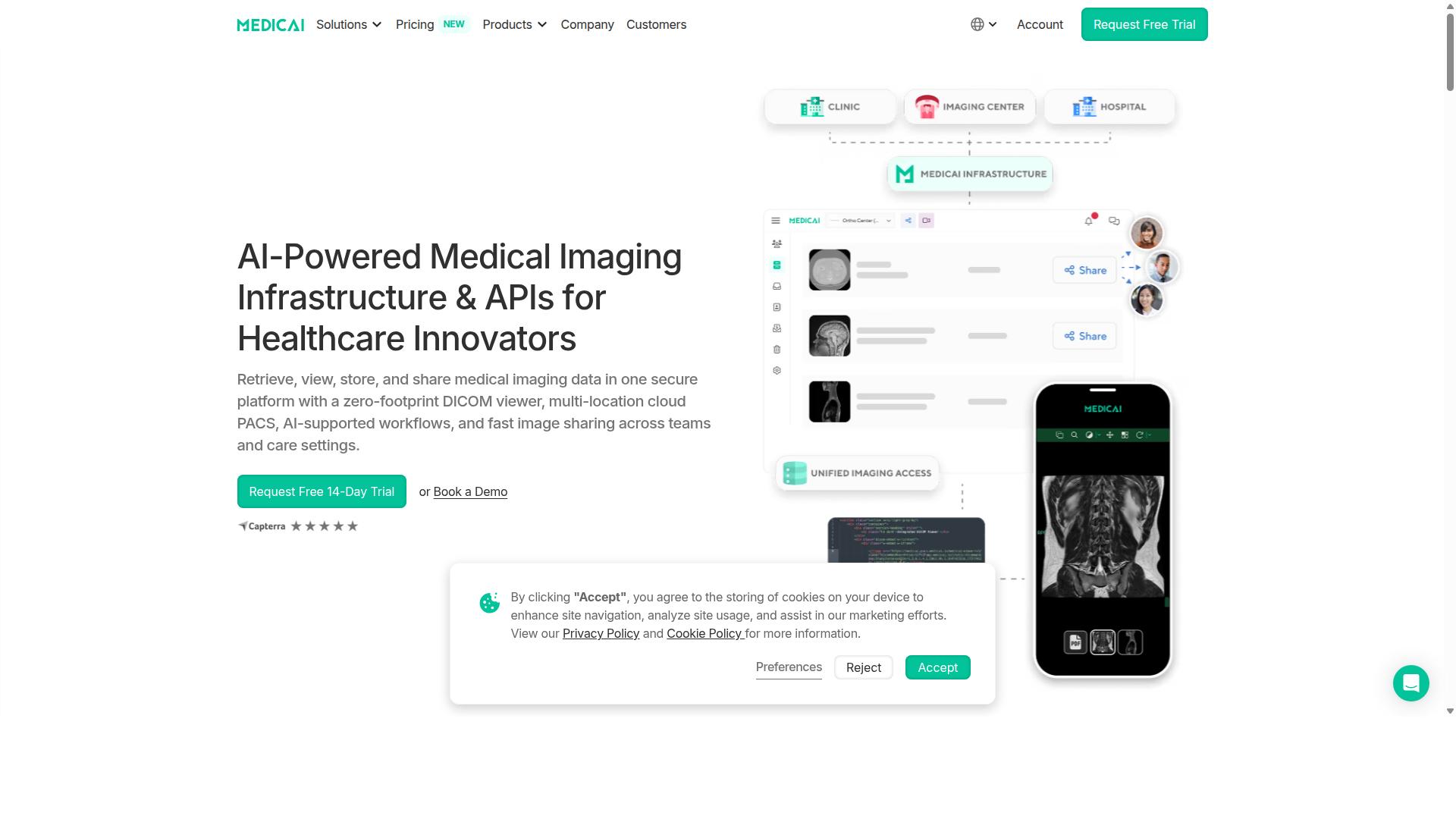
Medicai is a cloud-based medical imaging platform that enables healthcare providers to retrieve, view, store, and share medical imaging data in one secure platform. This service helps medical teams access patient scans without complicated setup or local servers.
The platform includes a zero-footprint DICOM viewer that runs directly in web browsers. Users can open medical images on any device without installing software or managing updates.
Healthcare providers benefit from the cloud-based nature of the system since files remain accessible from multiple locations. The service supports Imaging Infrastructure as a Service, which reduces hardware needs for radiology departments.
Medical teams can use Medicai across hospitals and clinics. The system connects imaging workflows while maintaining data security standards that healthcare organizations require.
Why Medicai Leads in Robust Mobile Support
Mobile-first design choices separate Medicai from legacy PACS systems. Healthcare imaging platforms that prioritize tablets and smartphones deliver faster access to diagnostic tools. Radiologists, technicians, and referring physicians can review studies from any location.
The zero-footprint viewer supports iOS, Android, and tablets without requiring software installation. Cross-platform compatibility means clinicians use the same interface across devices. This eliminates compatibility issues that slow down patient care.
Offline access with cloud sync keeps critical studies available when connectivity drops. Images download securely to the device for later review. Once the connection returns, updates automatically transfer back to the central system.
Bandwidth optimization for lossless image compression reduces transfer times while preserving diagnostic quality. Compressed studies load quicker without compromising clinical detail. This matters most in rural or mobile settings where network speeds vary.
Key Features and What Makes Medicai Stand Out
A unified feature set addresses clinical workflows from image upload to secure collaboration. Medicai supports healthcare imaging across mobile platforms while maintaining compliance standards. The platform serves 70 clinics and hospitals with over 10,000 active doctors.
Users access imaging data through multiple entry points that sync across devices. Cross-platform capabilities allow radiologists to review studies whether they work on tablets or smartphones. Cloud-based architecture eliminates local storage requirements.
Integration points connect with existing hospital systems through standard protocols. Medical device integration supports data flow from acquisition to interpretation. The system handles 2M+ imaging studies uploaded to date.
Zero-Footprint DICOM Viewer for Mobile Access
The zero-footprint viewer delivers full DICOM functionality without local installs. Browser-based access works on iOS and Android tablets without additional software. Clinicians open studies directly in mobile browsers.
Tools support measurement and annotation tasks during image review. Annotation tools include basic markup while measurement tools provide distance and area calculations. Users maintain diagnostic quality across different screen sizes.
The platform recorded 300k+ DICOM visualizations in the last year. Tablet optimization adjusts interface elements for touch interaction. Image compression maintains lossless quality during transmission.
Cloud PACS and Secure Image Sharing
Cloud PACS centralizes storage while maintaining HIPAA and GDPR compliance. Medical Image Exchange enables secure transmission between facilities. Vendor Neutral Archive stores data independent of specific equipment vendors.
Encryption standards protect data during transmission and storage. Role-based access controls limit viewing permissions to authorized personnel. Backup and Disaster Recovery services protect against data loss.
The platform follows OWASP security guidelines for application protection. Secure transmission protocols maintain patient data privacy across networks. User authentication verifies identity before granting system access.
AI-Supported Workflows on Mobile Devices
AI assistance accelerates mobile workflows without sacrificing diagnostic quality. AI-assisted diagnosis provides preliminary analysis support during image review. Auto 3D reconstruction generates volumetric views from standard series.
Multiple users can review the same study simultaneously from different locations. Real-time multi-user collaboration supports tumor board discussions across institutions. The platform processed 1M+ studies annually with 50M+ yearly API transactions.
Workflow efficiency improves when radiologists access studies through mobile interfaces. Push notifications alert users when new images arrive or reports require review. The system reduces diagnosis time by 65 percent through streamlined access.
Pricing and Plans
Two subscription tiers scale storage and connected locations. Starter and Standard plans cover different needs for healthcare teams that require mobile support for medical imaging workflows.
Starter costs $249 per month. This tier includes 500 GB cloud storage, unlimited user accounts, and zero connected locations. It works well for smaller practices that manage imaging access through mobile devices without on-site PACS integration.
Standard costs $749 per month. This tier provides 2 TB cloud storage, unlimited user accounts, and one connected location. It suits growing radiology departments that need DICOM gateway connectivity for tablet and phone access.
Both plans bill monthly only. Enterprise customers can request custom pricing for multiple connected locations and external access points. DICOM gateway setup costs $1,000 one-time per location.
A 14-day trial of Starter plan features is available with no credit card required. Per-study pricing options exist for enterprise customers who need flexible mobile imaging access across different healthcare settings.
Trust Signals
Compliance certifications and uptime partnerships signal reliability. Medicai prioritizes security through HIPAA and GDPR compliance while maintaining a FDA and CEE cleared viewer.
These standards protect patient data across healthcare imaging workflows. The DICOM viewer operates within strict regulatory frameworks that many medical facilities require.
Partnerships with Microsoft Azure and Amazon AWS provide the infrastructure foundation for consistent mobile performance. These cloud providers deliver the scalability needed for radiology apps handling large imaging datasets.
Additional partnerships with New Relic and Atlassian support monitoring and project management capabilities. These integrations help maintain platform stability across iOS and Android devices.
Healthcare organizations benefit from these trust signals when selecting mobile solutions for PACS integration. The combination of regulatory compliance and enterprise partnerships addresses core concerns about data security and system reliability in medical environments.
Who Should Use Medicai
Hospitals, imaging centers, and specialty clinics gain the most value.
Healthcare providers need reliable mobile access to medical imaging across multiple care settings. Medicai serves hospitals and imaging centers that require secure DICOM viewer capabilities on iOS and Android devices.
Specialty practices benefit from tablet optimization when reviewing studies during patient rounds. Orthopedics, neurology, and oncology departments use the platform for collaborative case review on mobile devices.
Radiology and cardiology teams access imaging studies through cross-platform functionality. Ophthalmology, ob-gyn, pulmonology, dentistry, and gastroenterology practices rely on secure transmission features for remote consultation.
Virtual care providers and telemedicine platforms integrate Medicai into their workflows. Teleradiology services use the platform to deliver reports across locations while maintaining HIPAA compliance.
Personal injury lawyers and tumor boards access shared imaging studies through multi-user access. Clinical trials and medical education organizations benefit from cloud sync capabilities that support research collaboration.
Patients access their own imaging through the Patient Portal. This broad user base reflects the platform's ability to serve diverse healthcare stakeholders who need mobile imaging access.
Final Verdict
Medicai combines mobile accessibility, compliance, and scalability for modern imaging departments. The platform addresses the core needs of healthcare imaging professionals through its mobile-first design and security framework.
Mobile support includes iOS and Android compatibility with tablet optimization. Users can access studies across devices without compromising image quality or workflow efficiency.
Security measures follow HIPAA compliance standards with encryption protocols and user authentication systems. Role-based access controls protect patient data privacy during transmission and storage.
The platform maintains a storage capacity of 1.7M plus studies while processing over one million studies annually. These metrics demonstrate reliable performance for high-volume imaging environments.
Cross-platform functionality supports PACS integration for seamless data exchange between systems. Cloud sync capabilities enable real-time collaboration among multiple users across different locations.
Healthcare facilities seeking robust mobile support can contact Medicai USA at 7901 4th St N, STE 300, St. Petersburg, FL, 33702 or call +1 (832) 220 1035. The Romania office at 53-55 N Filipescu, 5th Floor, Sector 2, Bucharest, 020961 offers additional support at +40 316 305 875. Email inquiries reach [email protected] for detailed consultation.
Recommended Resources: