Why Is Medicai the Best for Handles Heavy Imaging Loads?
Radiology teams often hit upload limits or slow retrieval times when daily scans exceed a few hundred studies. Some tools slow down or require extra hardware once the volume rises. Medicai keeps access steady without local servers.
By the end of this article you will know how the platform stores and routes large image files, what its viewer and AI tools actually do during peak hours, and whether the subscription fits your case volume and multi-site workflow.
What Is Medicai?
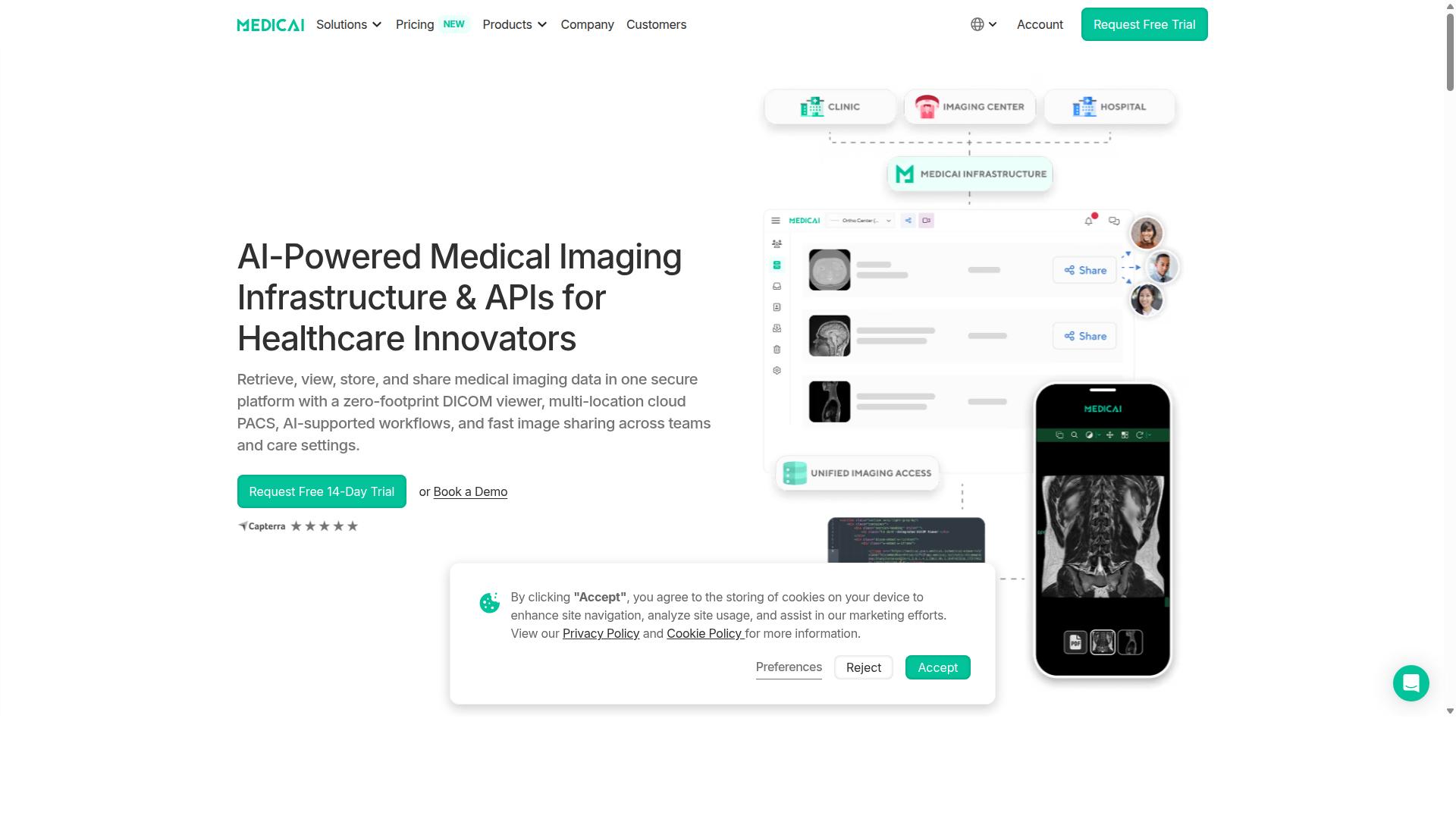
Medicai is a cloud-based medical imaging platform that consolidates the entire imaging workflow into one secure, web-accessible system. The platform operates as a zero-footprint DICOM viewer that eliminates the need for local software installations on clinical workstations. Healthcare teams access medical imaging data directly through standard web browsers without additional downloads or updates.
Four core capabilities define the Medicai platform. Users retrieve imaging studies from connected PACS systems. They view CT, MRI, X-ray, and ultrasound images through the browser-based interface. Storage occurs through the multi-location cloud PACS architecture. Secure sharing enables collaboration across care teams and different sites.
Global availability allows healthcare organizations to access medical imaging data from any location with internet connectivity. The single-tenant architecture provides dedicated resources for multi-site healthcare organizations. Each tenant operates independently while maintaining the same security standards and performance capabilities.
Medicai functions as Imaging Infrastructure as a Service for facilities managing heavy imaging loads. The platform supports high-resolution scans and large datasets without requiring on-premise hardware investments. Organizations gain access to medical imaging workflows that scale according to their operational demands.
Why Medicai Excels at Heavy Imaging Loads
High-volume radiology departments process thousands of large studies daily; Medicai's infrastructure is built to handle that sustained throughput without performance degradation.
The platform manages 1M+ studies transacted or processed per year and maintains 1.7M+ studies in storage. Server clustering distributes incoming workloads across multiple nodes to prevent bottlenecks during peak hours.
GPU-accelerated parallel processing accelerates image rendering and reconstruction tasks. This approach supports simultaneous handling of CT, MRI, and 3D reconstruction workflows without queuing delays or quality loss.
Lossless compression paired with image streaming reduces bandwidth usage while preserving diagnostic quality. High-resolution scans reach viewing stations faster even over limited network connections.
CT studies benefit from rapid slice loading that maintains spatial accuracy. MRI sequences stream in order without compression artifacts affecting tissue contrast. 3D reconstructions update in real time as users adjust viewing angles.
These capabilities rely on Microsoft Azure infrastructure that scales storage and compute resources dynamically. 300k+ visualizations of DICOM studies completed in the last year demonstrate consistent performance under heavy imaging loads.
Key Features and What Makes Medicai Stand Out
A robust medical imaging platform must combine storage, visualization, and AI support in a single HIPAA-compliant environment.
Medicai addresses heavy imaging loads by delivering a unified solution that manages storage, visualization, and AI support together. The platform serves hospitals, radiology groups, and teleradiology providers who face growing volumes of CT, MRI, and X-ray studies.
The system scales across multiple sites while keeping data secure and accessible. Organizations can expand capacity without rebuilding their entire infrastructure.
Three core capabilities drive this performance: cloud PACS architecture, zero-footprint viewing, and AI-supported workflows. Each component works together to maintain speed and reliability under demanding conditions.
Cloud PACS and Vendor Neutral Archive
Medicai's Cloud PACS doubles as a vendor-neutral archive that ingests studies from any modality while maintaining a single source of truth across locations.
The Medical Image Exchange module allows secure sharing between facilities. Patient Case Management keeps imaging records organized with patient history and prior studies readily available.
Integration happens through DICOM gateway connectors. These tools link directly with existing EMR, EHR, and RIS systems without requiring major workflow changes.
Automatic backup and disaster-recovery policies protect data integrity. Studies remain accessible even if local equipment fails or network issues occur.
The architecture supports multi-site access, allowing radiologists and specialists to review cases from any authorized location. This eliminates delays associated with physical media transfer or limited server capacity.
Zero-Footprint DICOM Viewer
The zero-footprint viewer streams studies directly in any modern browser, eliminating the need for local software or VPN tunnels.
High-resolution scans display quickly even when bandwidth is limited.
No data caching on local machines reduces security risks. Patient information stays protected on secure servers rather than distributed across individual workstations.
Automatic audit logging records every access event. Administrators can track who viewed each study and when the access occurred.
The viewer handles 3D reconstruction and ultrasound sequences without additional plugins. This capability supports complex cases that require detailed visualization across different imaging modalities.
AI-Supported Workflows
Built-in AI triage accelerates preliminary reads by flagging urgent findings before radiologist review.
Medicai's API layer handles over 50 million yearly transactions. This capacity connects to third-party AI models such as Rayscape.ai for specialized analysis.
The Radiology AI Co-Pilot and AI-Powered Diagnostics features support this process. Radiologists receive prioritized worklists that highlight urgent cases first.
This approach reduces time between image acquisition and specialist review. Organizations can manage higher study volumes while maintaining diagnostic quality and response times.
Pricing and Plans
Medicai offers transparent monthly subscriptions that scale with storage volume and connected locations. The platform provides clear pricing tiers designed for radiology departments handling heavy imaging loads. Each plan matches specific study volumes and operational requirements.
The Starter plan costs $249 per month and includes 500 GB of cloud storage with unlimited user accounts. This tier supports smaller radiology departments with moderate imaging volumes. It works well for practices processing standard CT, MRI, and X-ray studies without needing multiple facility connections.
The Standard plan costs $749 per month and provides 2 TB of cloud storage plus one connected location. This option suits medium-sized departments managing higher study volumes. It handles increased demands from multiple modalities including ultrasound, 3D reconstruction, and high-resolution scans.
Enterprise customers receive custom pricing with flexible storage options and multiple connected locations. This tier accommodates large health systems with distributed imaging operations. Per-study pricing is available for organizations with variable imaging loads.
Yearly billing provides 15 percent savings across all tiers. The Starter plan reduces to $209 monthly when paid annually, while the Standard plan drops to $639 monthly. A free 14-day trial of Starter plan features is available without requiring a credit card.
DICOM Gateway Setup costs $1,000 one-time per location. This fee applies to organizations connecting physical imaging equipment to the cloud platform. Refunds are not available for partial subscription periods.
Trust Signals
Compliance certifications and proven study volumes reassure healthcare IT teams evaluating new imaging platforms.
Healthcare organizations handling heavy imaging loads need systems that meet strict regulatory standards. HIPAA and GDPR compliance ensures patient data remains protected under established frameworks. These certifications help institutions meet their own compliance obligations when adopting new medical imaging solutions.
Technical clearances add another important layer of assurance. FDA and CEE cleared viewers demonstrate that Medicai has passed rigorous safety and quality evaluations. This matters for facilities processing CT, MRI, and other high-resolution scans where diagnostic accuracy depends on reliable software performance.
Volume metrics show real-world adoption across demanding environments. 300k+ DICOM visualizations in the past year reflect consistent use by radiologists and specialists working with complex imaging workflows. Such activity indicates the platform manages substantial data loads without performance issues.
Infrastructure partnerships strengthen system reliability during peak usage periods. Microsoft Azure and Amazon AWS provide the cloud backbone for data storage and processing. New Relic monitors system performance to maintain uptime when multiple sites access imaging studies simultaneously.
Who Should Use Medicai
Hospitals and imaging centers handling high-resolution CT, MRI, and ultrasound studies gain the most immediate value from Medicai.
Orthopedics specialists rely on detailed bone imaging. They use Medicai to review multi-slice CT scans during pre-surgical planning for joint replacements.
Neurology teams examine brain and spine MRI sequences. Medicai supports their workflow when reviewing complex tumor cases across multiple image series.
Oncology departments track tumor progression over time. They depend on Medicai to compare serial PET-CT studies during treatment monitoring.
Radiology groups manage large daily caseloads. Medicai enables them to access and report on thousands of studies without local hardware limitations.
Cardiology practices interpret cardiac CT angiography. They utilize Medicai to measure vessel stenosis across high-resolution coronary studies.
Ophthalmology clinics review retinal OCT scans. Medicai helps them track macular changes in patients with diabetic retinopathy.
Ob-gyn practices examine fetal ultrasound volumes. Medicai supports their review of detailed 3D reconstructions during anomaly scans.
Pulmonology specialists analyze chest CT patterns. They use Medicai when evaluating interstitial lung disease across multiple slice thicknesses.
Dentistry offices review cone-beam CT scans. Medicai assists them in planning implant placements with precise bone measurements.
Gastroenterology teams interpret abdominal MRI studies. Medicai helps them assess liver lesions during hepatocellular carcinoma surveillance.
Endocrinology physicians examine thyroid ultrasound images. They rely on Medicai when monitoring nodule growth across follow-up appointments.
Final Verdict
For organizations seeking a scalable, zero-footprint imaging platform that meets strict compliance standards, Medicai offers a compelling, all-in-one solution.
The platform processes over one million studies each year and stores more than 1.7 million studies in the cloud. It also delivers over 50 million API calls annually while maintaining HIPAA and GDPR compliance.
These capabilities support radiology workflows that involve heavy imaging loads, including CT, MRI, X-ray, and ultrasound examinations. The system manages DICOM data, enables 3D reconstruction, and supports multi-site access for healthcare teams.
Medicai serves hospitals, imaging centers, and medical practices that require reliable cloud storage and web-based viewing. The zero-footprint viewer allows clinicians to access high-resolution scans without installing software.
Bandwidth optimization and lossless compression help maintain performance during peak usage. Load balancing and server clustering support parallel processing when multiple users access studies simultaneously.
Integration with EMR and EHR systems occurs through DICOM gateway connectors. This interoperability connects imaging data with existing hospital systems without disrupting current workflows.
Security features include encryption and audit logs to protect patient data. The vendor neutral archive design allows healthcare organizations to retain control of their imaging data while reducing infrastructure costs.
Medicai USA is located at 7901 4th St N, STE 300, St. Petersburg, FL 33702 and can be reached at +1 (832) 220 1035. Medicai Romania operates from 53-55 N Filipescu, 5th Floor, Sector 2, Bucharest 020961 and can be contacted at +40 316 305 875.
Recommended Resources: