Who's the Best for Advanced 3D Tooling: PostDICOM vs Medicai
Most teams comparing PostDICOM and Medicai need clearer answers on 3D tooling before budget approvals arrive. The choice affects how quickly radiologists can measure, annotate, and share complex studies without desktop installs or external viewers. Second, the decision now determines whether current workflows can scale across multiple sites without new hardware purchases.
By the end of this article you will see exactly which platform delivers stronger 3D rendering, multi-modality support, and AI-assisted workflows, together with the pricing differences that matter for your case volume. You will also know which option fits your current team size and which one fits if you plan to add AI-supported triage or remote reading locations in the next twelve months.
Quick Verdict: Medicai Leads in Advanced 3D Tooling
Medicai delivers a more comprehensive 3D tooling suite with higher processing volume and broader AI integration compared to PostDICOM. The platform supports medical imaging workflows across hospitals and clinics.
Users benefit from a zero-footprint viewer that eliminates the need for local installations. This approach simplifies deployment across radiology departments and supports remote access without additional software requirements.
Scalability evidence includes one-million-plus annual studies processed through the system. This volume demonstrates proven capacity to handle large imaging workloads across multiple healthcare facilities.
AI integration spans multiple areas of medical imaging analysis. The system processes DICOM studies with advanced visualization tools that support radiology collaboration and imaging analytics needs.
Integration examples include PACS connections and direct DICOM upload capabilities. These connections support radiology workflow efficiency without requiring complex setup processes.
Security compliance covers HIPAA and GDPR requirements along with OWASP guidelines. These standards help protect medical data during DICOM processing and 3D reconstruction activities.
Usage metrics show 300k-plus visualizations of DICOM studies in the previous year. This activity indicates active adoption across the platform's 10,000-plus active doctors.
Microsoft Azure partnership supports cloud storage infrastructure. The arrangement helps maintain performance during high-volume DICOM conversion and 3D rendering tasks.
PostDICOM offers general medical imaging capabilities. However, the platform lacks the documented processing volumes and integration examples that Medicai provides through its cloud platform.
At a glance: how Medicai compares to PostDICOM on the features that matter most.
| Feature | Medicai | PostDICOM |
|---|---|---|
| Advanced 3D Tooling | ✓ | ✓ |
What Is Medicai?
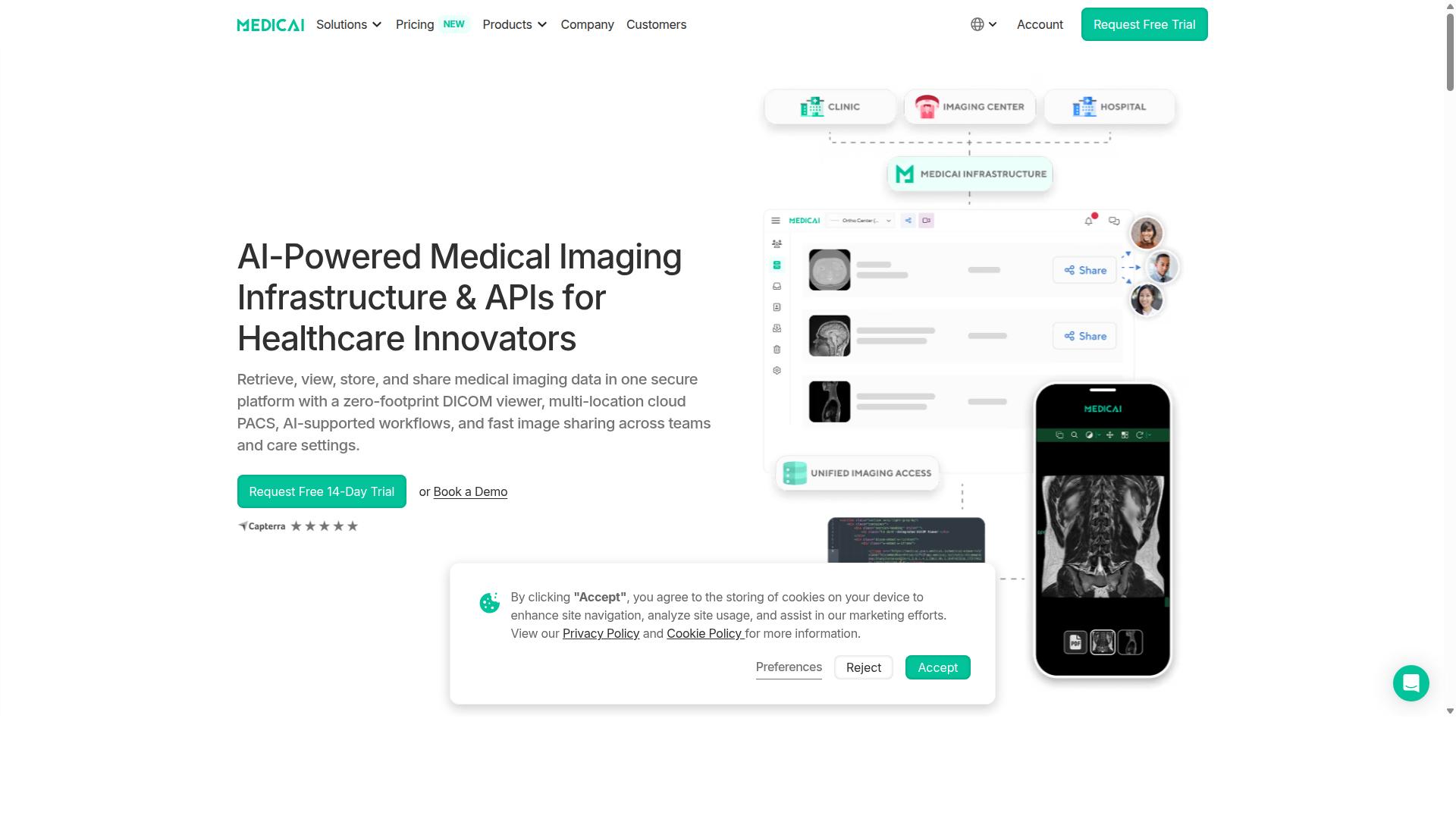
Medicai is a cloud-based medical imaging platform that consolidates retrieval, viewing, storage, and sharing of imaging data into one secure, zero-footprint environment.
The platform architecture uses a multi-location cloud PACS design. This setup supports healthcare organizations that operate across different sites or regions. Imaging Infrastructure as a Service forms the foundation that enables medical facilities to scale their radiology workflows without maintaining separate on-site servers.
Compliance features include HIPAA and GDPR standards for protecting patient data. FDA and CEE clearance status supports deployment in regulated medical environments where device certification is required for clinical use.
The platform includes a DICOM uploader for secure image transfer from various sources. A gateway component manages data flow between different systems. The vendor-neutral archive provides storage across multiple tiers that accommodate different volume and access requirements.
AI-supported workflows connect with the core imaging functions. These capabilities help radiology teams handle advanced 3D tooling tasks alongside standard viewing and reporting needs. Fast image sharing connects care teams across different locations without requiring additional software installations.
What Is PostDICOM?
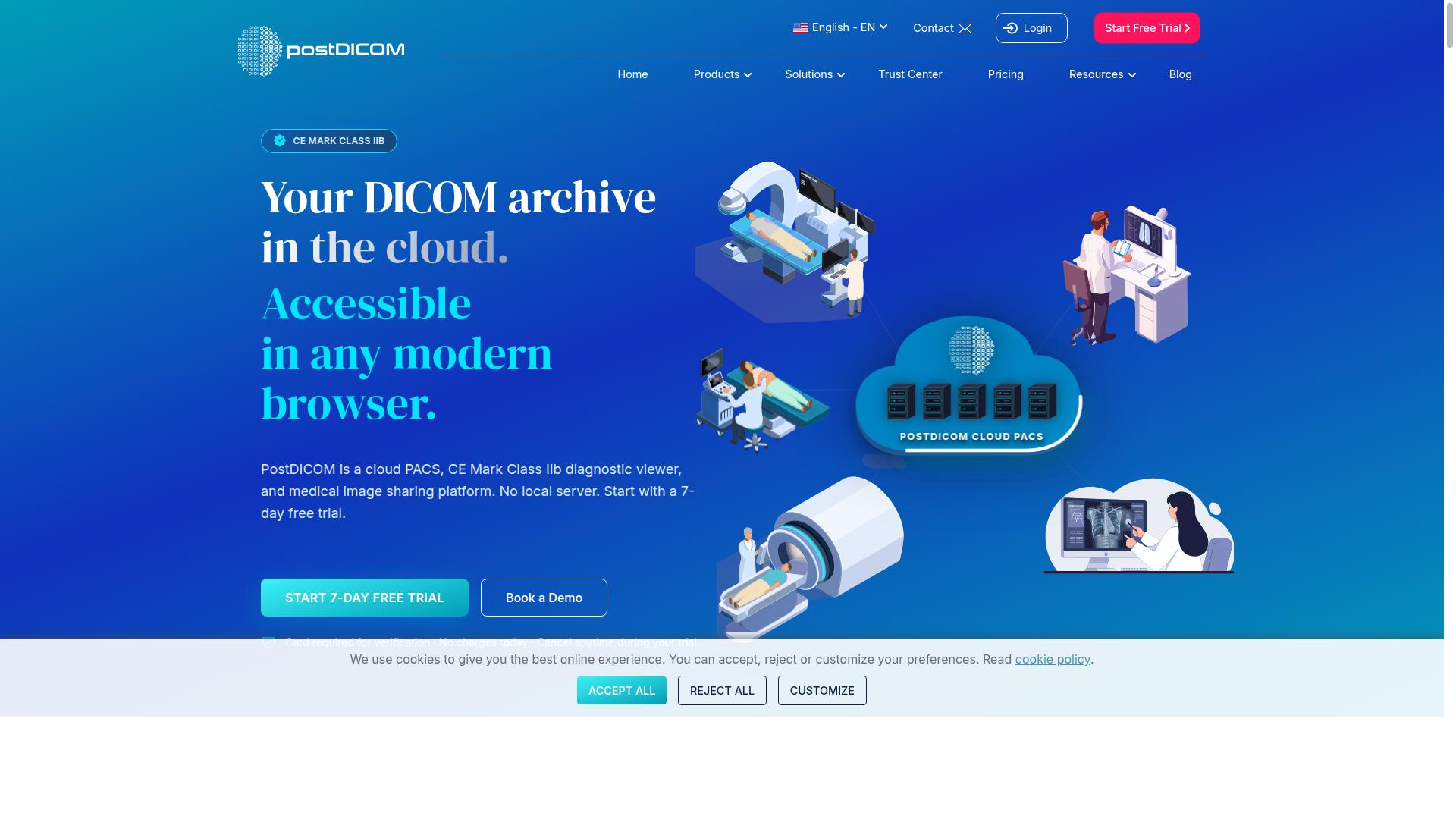
PostDICOM is a cloud-based DICOM viewer and PACS alternative aimed at smaller practices and imaging centers seeking browser-based access. The platform focuses on standard PACS functions that help users store, view, and share medical imaging data through a web interface.
Many facilities choose this type of solution when they want to avoid maintaining physical servers and prefer DICOM upload through standard web browsers. The software handles basic DICOM compliance and offers cloud storage for medical records without requiring local infrastructure.
Users typically access the system through any modern browser, which reduces setup time compared to traditional desktop installations. This approach appeals to radiology practices that need straightforward access to imaging software without complex IT requirements.
PostDICOM provides core radiology tools for viewing and managing medical imaging data in a centralized cloud platform. The system supports standard DICOM processing workflows that smaller facilities use for routine imaging needs.
Features Compared
A side-by-side feature review reveals clear gaps in 3D depth, AI workflow maturity, and interoperability scope between the two platforms.
PostDICOM offers standard DICOM viewing capabilities. Medicai delivers enterprise-grade 3D tooling with measurable scale and speed advantages.
Key differences emerge across rendering depth, modality coverage, and AI integration capacity. These domains determine clinical utility for advanced imaging workflows.
3D Rendering & Visualization
Medicai's 3D reconstruction engine processes 300,000+ DICOM studies annually, delivering real-time multi-planar reformation and volume rendering directly in the browser.
The platform handles 300k+ visualizations of DICOM studies in the last year. This volume demonstrates production-ready performance for demanding clinical environments.
Multi-planar reformation (MPR) and volume rendering operate through a zero-footprint viewer. No plugins or local installations are required for full functionality.
PostDICOM provides basic 3D capabilities with limited real-time performance at scale. Medicai maintains consistent rendering speeds across large study volumes.
The browser-based approach eliminates compatibility issues common with plugin-dependent solutions. Clinicians access full 3D functionality from any compliant device.
Multi-Modality Support
Medicai supports CT, MRI, X-ray, ultrasound, PET, and mammography within a single unified viewer while maintaining full DICOM metadata integrity.
The vendor neutral archive ensures consistent data handling across specialties such as orthopedics, neurology, and cardiology. All modalities maintain original DICOM tags and attributes.
PostDICOM handles common modalities with variable metadata preservation. Medicai guarantees complete DICOM compliance across the full modality range.
Specialty workflows benefit from unified access to diverse imaging data. Orthopedic surgeons, neurologists, and cardiologists work within the same interface.
The archive structure supports 1.7M+ studies in storage with consistent retrieval performance across all supported modalities.
AI-Assisted Workflows
Medicai integrates third-party AI models via 50 million yearly API transactions, enabling automated measurement, triage, and reporting directly inside the viewer.
Partners including Rayscape.ai and MD.ai provide specialized AI capabilities through the Medicai Imaging API. Automated measurement and triage functions reduce interpretation time.
Research indicates Medicai reduces diagnosis time by 65%. The AI co-pilot augments radiologist workflow without replacing clinical judgment.
PostDICOM offers limited AI integration options. Medicai processes 50M+ yearly API transactions with established radiology AI partners.
The platform supports 10,000+ active doctors across 70 clinics and hospitals. This adoption reflects proven AI workflow reliability in clinical practice.
Pricing Compared
Medicai's transparent, usage-based tiers start at $249 per month for 500 GB and scale to multi-terabyte deployments with no per-user fees.
Starter plan gives teams 500 GB of cloud storage plus unlimited user accounts. Standard plan expands capacity to 2 TB and connects one location for $749 monthly. Both tiers include a 14-day trial of Starter features with no credit card required.
PostDICOM pricing follows a different model with charges typically assessed per study or per user. The exact structure varies by deployment size and usage patterns. Organizations evaluating this option should request current quotes directly from the vendor.
Yearly billing on Medicai reduces Starter cost to $209 per month and Standard to $639 per month, delivering 15 percent savings for annual commitments. Enterprise customers receive custom pricing for larger storage volumes and multiple connected locations.
One-time setup fees for DICOM Gateway reach $1,000 per location when organizations need on-premises connectivity. Per-study pricing remains available for enterprise customers who prefer usage-based billing instead of monthly subscriptions.
PostDICOM maintains a flexible approach but does not publish detailed tier breakdowns publicly. This lack of transparency makes direct budget planning more difficult for medical imaging teams comparing cloud platforms.
The unlimited user accounts in both Medicai plans eliminate per-seat costs that often appear in other radiology software solutions. Teams can add radiologists, technicians, and referring physicians without additional charges.
Cloud storage allocation scales predictably from 500 GB to 2 TB and beyond. This structure supports 3D reconstruction workflows, DICOM archive needs, and medical visualization projects that generate large file volumes over time.
Who Should Choose Medicai
Hospitals, imaging centers, and specialty groups handling high imaging volumes or requiring robust 3D and AI tooling will benefit most from Medicai.
Storage requirements vary significantly across healthcare organizations. The 500 GB to multi-TB tiers align with different annual study volumes depending on facility size and specialty focus.
Smaller practices processing fewer than 5,000 studies per year typically find 500 GB sufficient for active archives. Larger institutions running 20,000 or more annual studies benefit from multi-TB configurations that accommodate growing DICOM archives.
Global availability ensures that multi-site health systems can access consistent medical imaging platform performance regardless of geographic location. This matters for organizations operating across regions with different compliance frameworks.
HIPAA and GDPR compliance supports data handling requirements for international operations. Multi-site systems need unified security standards that satisfy both U.S. healthcare regulations and European data protection rules.
Specialty care providers across orthopedics, neurology, oncology, radiology, and cardiology often require advanced 3D reconstruction capabilities. Medical visualization tools become essential for complex cases that demand detailed anatomical analysis.
Virtual care providers and telemedicine platforms rely on reliable cloud platform access for remote consultations. Teleradiology services benefit from consistent DICOM upload and processing across distributed networks.
Organizations managing medical data for clinical trials or tumor boards need standardized workflows that support multiple stakeholders. Radiology collaboration features enable secure sharing while maintaining compliance standards.
Patient portals extend access to imaging records for direct patient engagement. This supports modern care delivery models where patients participate actively in their treatment decisions.
Who Should Choose PostDICOM
Smaller practices or single-location clinics that need only basic browser-based viewing and lack complex 3D or AI requirements may find PostDICOM sufficient. Such teams often work with straightforward imaging workflows that do not require advanced rendering or analytical tools.
General practices handling routine scans can benefit from a lighter-weight platform. These facilities typically manage standard image viewing without specialized reconstruction or processing needs.
Budget-conscious organizations that prioritize simplicity over advanced imaging features may also prefer this option. PostDICOM serves users who require a straightforward DICOM viewer without extensive PACS integration or collaboration capabilities.
Clinics focused on individual patient review rather than team-based radiology workflows often maintain adequate functionality with basic cloud storage. The platform supports standard medical imaging tasks while avoiding the complexity that larger institutions require.
Single-location facilities with limited technical resources may appreciate the reduced learning curve. Providers who need occasional DICOM upload and basic viewing can complete their tasks without advanced medical visualization tools or imaging analytics.
Final Verdict
For organizations prioritizing scalable 3D tooling, AI integration, and proven high-volume processing, Medicai offers the stronger long-term platform.
Annual volume exceeding one million studies demonstrates consistent capacity to handle enterprise radiology demands. This throughput reflects infrastructure reliability that supports continuous clinical operations without interruption.
Storage capacity reaching 1.7 million studies provides organizations with substantial archive space for growing medical imaging needs. The scale accommodates longitudinal patient data across multiple specialties and time periods.
Fifty million API transactions establish Medicai's proven interoperability across healthcare systems and third-party applications. This transaction volume indicates robust integration capabilities for complex hospital environments.
PostDICOM may serve smaller practices adequately, yet organizations requiring advanced 3D tooling at scale benefit from Medicai's demonstrated processing capabilities and cloud architecture.
Organizations evaluating 3D medical imaging platforms can contact Medicai USA at 7901 4th St N, STE 300, St. Petersburg, FL, 33702 or call +1 (832) 220 1035. European inquiries reach Medicai Romania at 53-55 N Filipescu, 5th Floor, Sector 2, Bucharest, 020961 via +40 316 305 875. Email [email protected] for evaluation inquiries and platform demonstrations.
Recommended Resources: