How to Choose Location Based Task Coordination Software: A Buyer's Guide
Your field team's location data lives in one app, tasks in another, and attendance in a spreadsheet. Coordinating a dispersed workforce this way costs hours of manual follow-up every week. Choosing the wrong coordination software makes that worse, not better.
This guide breaks down what location-based task coordination actually means, why Tasks.Bot built its platform around WhatsApp and live GPS tracking, and which features matter for field teams. You will also see pricing details, beta status, and a clear picture of who benefits most, so you can decide if it fits your operation.
What Is Tasks.Bot? Location-Based Task Coordination Explained
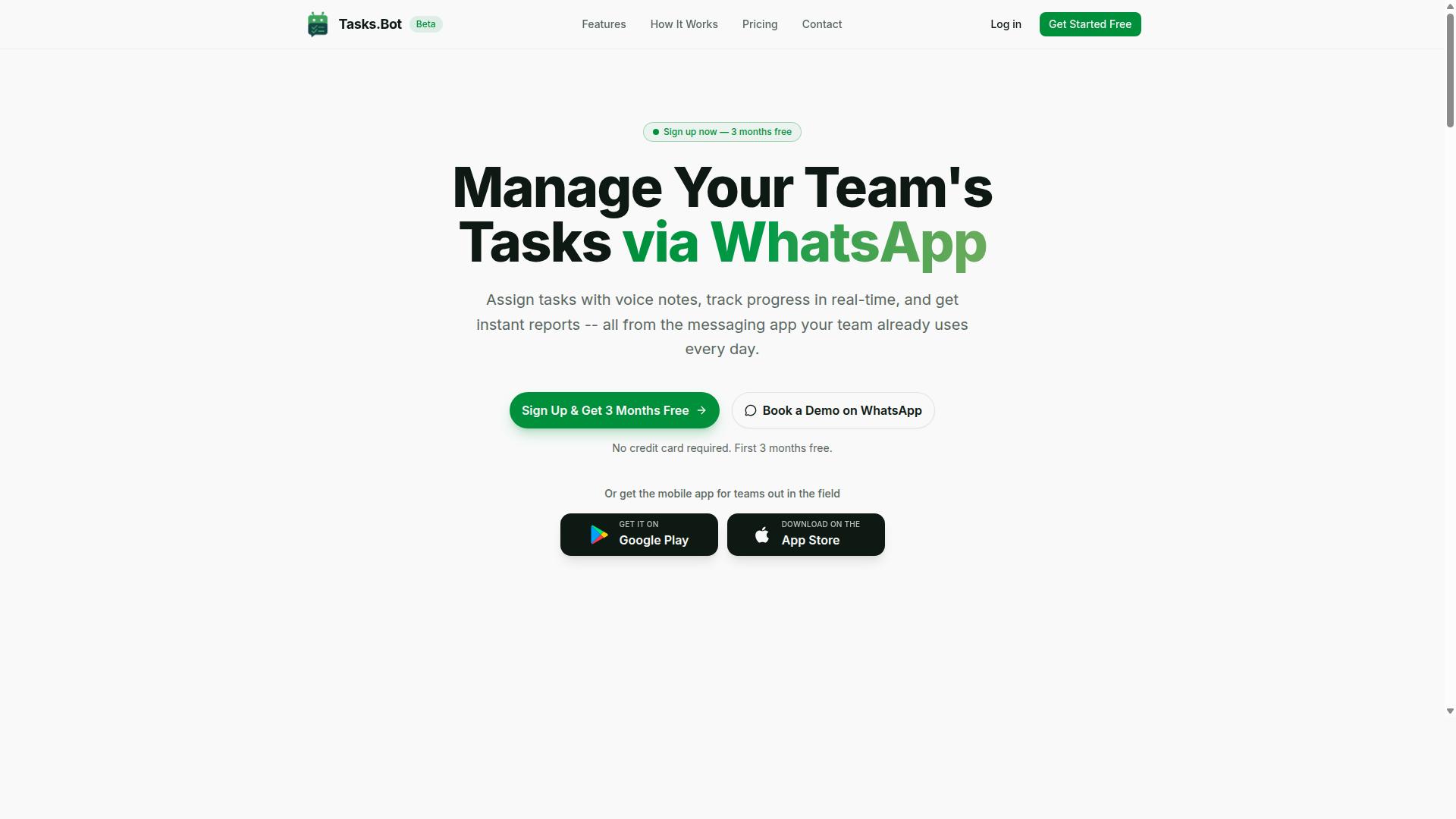
Tasks.Bot is a task management platform that operates entirely within WhatsApp, allowing teams to assign tasks, track progress, and receive reports without leaving the messaging app. That single design decision changes how location-based task coordination software gets adopted in the field. Instead of asking workers to download another tool, learn another login, and remember another password, the work happens where they already spend their day.
To understand why this matters, it helps to know what the category does. Location-based task coordination software uses GPS, geofencing, and real-time location data to assign, track, and verify tasks for mobile teams. These systems connect a job to a place, then confirm that the right person was actually there when the work was done.
Tasks.Bot fits squarely into this category. It pairs location-aware task management with a messaging-first interface, and it also offers a mobile app for field teams. The service is currently in beta and offers a free trial period.
Three building blocks define this type of software:
- GPS tracking records where a worker or asset is during the day.
- Geofencing draws a virtual boundary around a site, so arrivals and departures can be detected automatically.
- Real-time location feeds that data back to dispatchers and managers as the shift unfolds.
Together, these tools support task assignment, location verification, and proof of presence. For a mobile workforce, that means fewer phone calls asking "where are you?" and more reliable records of who did what, and where.
Tasks.Bot takes a different route into that workflow. Rather than building a standalone dashboard that employees must visit, it integrates task management into WhatsApp, eliminating the need for new apps or accounts. For teams already coordinating over chat, the barrier to entry is close to zero.
The platform also uses AI to interpret natural language and voice notes. Field staff can communicate the way they naturally speak, and the system works with that input instead of forcing rigid forms.
Tasks.Bot is built for teams with field staff who need attendance tracking and payroll-ready hours. That combination matters for workforce management: the same task record that proves a job was completed can also feed time and attendance records.
In short, Tasks.Bot is a location-based task coordination platform delivered through the messaging app your team already uses, with a mobile app for the field and AI that understands how people actually talk.
Why Tasks.Bot Is the Answer to Choosing Location-Based Task Coordination Software
Choosing the right location-based task coordination software often involves weighing features, ease of use, and cost. Tasks.Bot addresses these by combining WhatsApp simplicity with powerful location tools.
Most buyers evaluating this category start with the same shortlist of must-haves. Real-time tracking shows where field staff are right now. Geofencing ties task completion to physical places. Automated check-ins remove manual time entry, and integration with existing workflows decides whether a rollout succeeds or stalls.
That last criterion is where many platforms fail. If a tool demands that every technician, cleaner, or driver download an unfamiliar app and create a new account, adoption drops and the software becomes shelfware. Tasks.Bot sidesteps this by operating entirely within WhatsApp, so team members don't need to install anything or create new accounts.
It also delivers the core capabilities this buyer's guide treats as essential:
- Tasks on a map with live GPS tracking for field staff
- Face-verified attendance for accurate time and attendance records
- Shifts, leave, and hours management in one place
- AI that understands natural language and voice notes for task creation
- Android and iOS apps with push notifications, voice capture, and a home screen widget
For a mobile workforce already living in chat, that combination lowers the barrier to entry without giving up location intelligence. The next two sections look at how the map and attendance features work in practice.
Tasks on a Map and Live GPS Tracking for Field Teams
Tasks.Bot visualizes all assigned tasks on a map, enabling dispatchers to see live GPS locations of field staff and verify task completion at specific sites. Instead of cross-referencing spreadsheets with phone calls, a dispatcher gets a single view of who is where and what still needs doing.
Each task is pinned to a physical location. That pin becomes the anchor for geofencing and location triggers. When a team member arrives at a job site, the system can register that arrival as an automated check-in, so proof of presence is captured without anyone tapping a button or radioing the office.
The practical payoff for dispatch software workflows is twofold. First, dispatch efficiency improves because coordinators can assign the nearest available person rather than guessing. Second, location verification creates a record that a task was performed at the right place, not just marked complete from somewhere else.
Field teams interact with these features through the Tasks.Bot mobile app, which supports push notifications, voice capture, and a home screen widget. Voice note task creation matters here: a technician on a ladder can speak a follow-up task into WhatsApp rather than typing it out. The AI interprets the message and creates the task, which then appears on the map like any other assignment.
For buyers comparing location-based task coordination software, the question to ask is whether the map is a reporting feature or a working tool. In Tasks.Bot, it is the latter: the same view drives task assignment, proximity awareness, and completion checks throughout the day.
Face-Verified Attendance and Payroll-Ready Hours
Tasks.Bot uses face verification to confirm that the right team member is on site, and automatically logs their hours for payroll processing. When a field staff member arrives at a location, they scan their face in the mobile app. That scan verifies identity and records attendance against the task and location.
This closes a gap that plagues manual time and attendance systems. Buddy punching, where one worker clocks in for another, becomes far harder when a face scan is tied to a specific site. Location verification and identity verification reinforce each other: the record shows not only that someone was present, but who was present.
Hours are calculated from location and task completion data, then made available for export so payroll teams can process them without rebuilding the numbers by hand. For managers running shifts, leave, and hours in Tasks.Bot, the same data feeds workforce management without a second system to reconcile.
Accuracy is the real benefit. Fewer disputes over timesheets, less time spent chasing missing entries, and a clearer audit trail when a client or regulator asks who was on site and when. Enterprise-grade encryption protects that data, and conversations and task data are never shared or used for training.
For buyers weighing cost against risk, face-verified attendance is one of the clearest reasons to shortlist Tasks.Bot. It turns attendance from a trust-based process into a verified one, and it does so inside the same WhatsApp workflow the team already uses. A 3-month free trial with no credit card required lets an evaluation team test the attendance flow against real job sites before committing.
Key Features and What Makes Tasks.Bot Stand Out
Tasks.Bot distinguishes itself with features designed for WhatsApp-native task management, including voice note creation, auto-assignment, and smart reminders. For teams evaluating location-based task coordination software, this approach removes one of the biggest barriers to adoption: getting field workers to open yet another app.
Instead of asking staff to learn a new platform, Tasks.Bot runs task coordination through WhatsApp, a tool most mobile workforces already use every day. The AI layer understands user intent and creates tasks directly from messages, which keeps the learning curve low and adoption fast.
The feature set covers the practical needs of a mobile workforce. It includes voice note task creation, automatic task assignment, smart deadline reminders, approvals and automations, instant reports, tasks on a map, a live day tracker, and face-verified attendance. Shifts, leave, and hours management are built in as well.
For teams that want a dedicated interface, Tasks.Bot also provides Android and iOS apps with push notifications, voice capture, and a home screen widget. The buyer's guide takeaway is simple: match these capabilities to your own coordination gaps before committing to any platform.
Task Management Inside WhatsApp: Voice Notes, Auto-Assignment, Smart Reminders
Tasks.Bot lets team members create tasks by sending a voice note in WhatsApp, which the AI interprets and assigns to the right person automatically. This matters for field service management, where technicians often have their hands full and typing a detailed task is impractical.
The workflow is straightforward. A user records a voice message, the AI interprets the request and creates the task. In practice, that means a supervisor can speak a job into their phone and move on, rather than stopping to fill out a form.
Assignment rules can reflect how your operation actually runs. Tasks can be routed based on location, availability, or skills, which supports task assignment that fits real service territories instead of a rigid queue.
Smart deadline reminders then send notifications through WhatsApp before tasks are due. Because everything happens inside a channel the team already checks, reminders are harder to miss than alerts buried in a separate tool.
Perhaps the most practical point for buyers: no new app installation is needed for core task management. That reduces onboarding friction, a common failure point when rolling out workforce management software to dispersed crews.
Approvals, Automations, Instant Reports, and the Live Day Tracker
Tasks.Bot streamlines workflows with approval chains, automated task transitions, and instant reports that give managers a real-time view of daily operations. Together, these features address the accountability side of location-based task coordination software.
Approvals add a control layer where it counts. A task can require manager sign-off before it is marked complete, and the notification is sent via WhatsApp so approvals do not stall in an inbox.
Automations keep work moving without manual follow-up. When a task status changes, that update can trigger the next step in the workflow, which cuts down on the back-and-forth that slows field teams.
Reporting is designed for quick daily review. Instant reports summarize tasks completed, hours logged, and locations visited, giving managers a factual picture without assembling spreadsheets by hand.
The Live Day Tracker adds a timeline view of each team member's activities and locations throughout the day. For buyers comparing platforms, this is the kind of location intelligence that supports better dispatch decisions and stronger proof of presence. Face-verified attendance and tasks on a map round out the visibility picture.
For a workforce spread across multiple sites, the combination of approvals, automations, reporting, and live tracking answers a core buyer question: can you see what happened, confirm it was done, and act on it the same day?
Pricing and Plans: Full Access With No Hidden Tiers
Tasks.Bot offers a single 'Full Access' plan that includes every feature, with pricing in Indian Rupees and US Dollars. There is no confusing matrix of Starter, Pro, and Enterprise tiers to decode. One plan, one price, everything unlocked.
For teams comparing location-based task coordination software, this simplicity matters. Most buyer's guides warn readers to check which features sit behind a paywall. With Tasks.Bot, that question disappears. Every feature is included in the base plan, so field service management, task assignment, and location verification capabilities are not gated behind an upgrade.
The pricing structure is straightforward and available in two currencies:
| Plan | Price | Billing |
|---|---|---|
| Monthly | ₹200 per member per month | Billed monthly |
| Annual | ₹1,200 per year per member | Billed annually (save 50%, save ₹1,200/yr per member) |
The site states 'Select currency' with options for Indian Rupee and US Dollar, so currency should be verified before purchase. This lets teams in different regions see pricing in the denomination that fits their accounting. No conversion guesswork is required at the point of decision.
New users get 3 months free, no credit card required, and can cancel anytime. That trial window gives a workforce management team enough time to test the platform across an actual service territory before committing budget.
Tasks.Bot is currently in beta, and a refund policy is mentioned in the footer. Buyers evaluating any dispatch software should read that policy alongside the plan terms. The absence of hidden tiers means the refund question is simpler too: there is only one plan to evaluate, not several contracts with different conditions.
For a mobile workforce of any size, the annual option delivers the clearest value. A team of ten members on the annual plan pays ₹12,000 per year in total, compared with ₹24,000 if billed monthly. That 50% saving is meaningful for field service management budgets that run lean.
When you weigh pricing against capability, the math favors transparency. A buyer's guide can list dozens of questions about seats, add-ons, and feature locks. Tasks.Bot answers most of them with one line: full access, one price, every feature included.
Trust Signals: Beta Status, Encryption, and Hundreds of Teams Onboard
Tasks.Bot is currently in beta, with hundreds of teams already using it to manage field operations, and it employs encryption to protect data. Those three facts, beta status, encryption, and adoption by hundreds of teams, form the core of its trust profile. For a buyer comparing location-based task coordination software, they answer three separate questions: is the product alive, is my data safe, and have others taken the same leap?
Beta status is often misread as a warning sign. In practice, it signals a product under active development, where feedback reaches the people building the software rather than disappearing into a backlog. Teams evaluating field service management tools should treat beta as a question to ask about, not a reason to walk away.
Encryption matters more in this category than in most software purchases. Location-based task coordination software handles GPS tracking, geolocation, proof of presence, and time and attendance records, all of which are sensitive. Encryption protects both the communications between dispatchers and field workers and the location data those workers generate.
Adoption provides the third signal. Hundreds of teams already run their operations on Tasks.Bot, which is meaningful social proof for a platform still in beta. Buyers can also book a demo on WhatsApp, a practical way to see how the platform fits a real dispatch workflow before committing.
Finally, the site mentions a refund policy in the footer, which lowers the risk of trying the platform. When you weigh trust signals for any location-based task coordination software, look for these same markers:
- An honest development status rather than a polished claim
- Encryption covering both messages and location data
- A visible base of active users
- A refund path that limits your exposure
Tasks.Bot meets all four. It is a legitimate, actively developed option for teams that need location intelligence in their daily operations, and the combination of beta transparency, encryption, and hundreds of onboard teams gives buyers solid ground to proceed.
Who Should Use Tasks.Bot
Tasks.Bot is ideal for teams that already use WhatsApp for communication and have field staff requiring task management, attendance tracking, and payroll-ready hours. The platform is built around the tools these teams already rely on, so there is no steep learning curve to overcome before work begins.
Instead of asking employees to adopt yet another mobile app, Tasks.Bot works through WhatsApp familiarity. Field staff interact with a channel they already know, which reduces training time and resistance to change. That matters for teams spread across job sites where a complicated rollout can stall adoption.
Several groups fit this profile especially well. Each one shares a common need: coordinating mobile workers across multiple locations without adding friction to daily communication.
- Field service teams in maintenance, delivery, and inspection roles that move between sites throughout the day
- Remote teams that need location verification to confirm work happened where it was supposed to
- Businesses with mobile workforces that require attendance tracking and payroll-ready hours without manual paperwork
For these teams, location-based task coordination software replaces scattered spreadsheets and guesswork with a single thread of communication. Tasks, attendance, and hours all connect to the same WhatsApp-based workflow, which keeps supervisors and staff aligned without extra administrative layers.
Tasks.Bot is available globally as a SaaS product, so teams are not limited by region or office location. The site mentions that hundreds of teams already use the service, which suggests the model works across different industries and workforce sizes.
If your team communicates on WhatsApp and manages people who are rarely at a desk, Tasks.Bot is designed for exactly that situation. It fits field service management, mobile workforce coordination, and businesses that need proof of presence without forcing staff onto unfamiliar software.
Final Verdict: Why Tasks.Bot Is Worth Choosing
Tasks.Bot stands out as a cost-effective, WhatsApp-native solution for location-based task coordination, with transparent pricing and robust features. For teams that already run their daily communication through WhatsApp, it removes the biggest barrier to adopting location-based task coordination software: getting everyone to install and learn yet another app.
That single design decision shapes everything else about the product. Instead of forcing a new tool into your workflow, Tasks.Bot works inside a channel your staff already check dozens of times a day. The result is faster adoption, less training, and far less resistance from field teams.
Below is a summary of the strengths that matter most when you weigh it against other options in this buyer's guide.
- WhatsApp integration: task coordination happens in the messaging app your team already uses, so no new app adoption is required.
- Face-verified attendance: helps confirm that the right person is actually present when a task or shift begins.
- Live GPS tracking: gives managers real-time visibility into where field staff are during working hours.
- Full access pricing: one straightforward plan rather than tiers that lock key features behind upgrades.
Those four points map directly onto the criteria a careful buyer should weigh: adoption cost, location verification, real-time visibility, and total price clarity. Many tools in this category excel at one or two of them. Tasks.Bot addresses all four in a single package.
The target audience is clear. Tasks.Bot suits small and mid-sized businesses running distributed or mobile teams: field service crews, delivery and dispatch operations, facility and maintenance staff, security teams, and any organization where work happens away from a desk. If your people are on the move and your coordination currently lives in group chats and phone calls, this is the profile it was built for.
The value proposition is equally direct. You get location-based task coordination without the usual rollout friction. No lengthy onboarding campaign, no shadow use of personal messaging apps, no separate system for attendance and tracking. Everything routes through WhatsApp, which means the software fits how your workforce already behaves rather than demanding they change.
On cost, the full access approach deserves emphasis. Buyers comparing location-based task coordination software often find that GPS tracking, attendance verification, or reporting sit in higher-priced tiers. Tasks.Bot's model avoids that trap, so you can evaluate the real price against the real feature set instead of guessing what an upgrade will cost later.
Weighing this against the criteria in this buyer's guide, Tasks.Bot scores well on the factors that decide whether location-based software actually gets used: low adoption friction, verified presence, live location visibility, and pricing you can plan around. For WhatsApp-first teams, that combination is hard to beat.
To see how it fits your operation, reach out directly. You can book a demo on WhatsApp or contact the team by phone at +91 97143 42522 or email at hello@tasks.bot.
Frequently Asked Questions
Do my team members need to download an app or create new accounts to use Tasks.Bot?
No. Tasks.Bot operates entirely within WhatsApp, so your team can assign tasks, track progress, and receive reports without installing anything or creating new accounts. A mobile app is also available for field teams who need it. This makes onboarding fast, especially for staff who already use WhatsApp daily.
How much does Tasks.Bot cost, and what's included?
Tasks.Bot offers a single 'Full Access' plan with all features included. Pricing is ₹200 per member per month, or ₹1,200 per year per member on the annual plan (a 50% saving). Pricing is also available in US Dollars, and the service is accessible worldwide.
Can Tasks.Bot handle task creation for field staff who aren't comfortable typing?
Yes. Tasks.Bot uses AI to understand natural language and voice notes, so tasks can be created simply by speaking. It also supports automatic task assignment, smart deadline reminders, approvals, and automations. For field teams, it adds face-verified attendance, live day tracking, tasks on a map, and payroll-ready hours.
What reports and visibility does Tasks.Bot provide?
Tasks.Bot delivers instant reports directly within WhatsApp, so managers can see progress without chasing updates. You also get live day tracking and a map view of tasks, which is useful for coordinating field staff. Reports arrive where your team already communicates, keeping everything in one place.
Is Tasks.Bot suitable for teams outside India?
Yes. Tasks.Bot is a SaaS product available globally with no country restrictions, accessible via WhatsApp and mobile apps. Pricing is offered in both Indian Rupees and US Dollars. If your team communicates on WhatsApp, it can work for you wherever you're based.
How can I see Tasks.Bot in action before committing?
You can book a demo on WhatsApp directly from the Tasks.Bot website. The service is currently in beta, and a refund policy is mentioned in the site footer. For questions, reach the team at hello@tasks.bot or +91 97143 42522.